No college degree? No problem. These five in-demand occupations are opening direct pathways to H-2B, H-2A, and EB-3 visa sponsorship — for immigrants with the right skills and certifications.
Getting a U.S. work visa as a foreign national is one of the most complex processes in the world — but it does not always require a college degree or years of postgraduate training. For immigrants who know where to look, certain high-demand occupational sectors offer something rare: a genuine, employer-sponsored path to legal U.S. employment through visa programs like the H-2B Temporary Non-Agricultural Worker Visa, the H-2A agricultural visa, and the EB-3 Employment-Based Green Card.
The key is understanding which industries are chronically understaffed, which employers are authorized to sponsor foreign nationals, and which certifications or work history will make your visa application stand out. This guide covers five occupational categories that U.S. immigration attorneys and career advisors consistently recommend to immigrants seeking employer-sponsored visas in 2026 — and explains exactly how to position yourself to qualify.
1. Warehouse and Logistics Workers — H-2B Visa and EB-3 Green Card Sponsorship
The U.S. logistics and warehousing sector is one of the fastest-growing industries in the country, driven by the explosive rise of e-commerce and same-day delivery demand. Companies like Amazon, UPS, FedEx, and major third-party logistics providers (3PLs) operate distribution networks that span the entire country — and they consistently struggle to fill roles with domestic workers alone, making this one of the strongest sectors for visa sponsorship USA in 2026.
Warehouse associate positions cover a wide range of functions: receiving and shipping freight, operating forklifts and pallet jacks, managing inventory systems, conducting quality control checks, and maintaining safety compliance under OSHA regulations. Entry-level warehouse roles are accessible to workers without formal education, while specialized positions — such as forklift operator, shipping coordinator, or warehouse supervisor — require certifications that significantly increase your employer-sponsored visa eligibility.
Visa Sponsorship Opportunities in Logistics
When domestic labor supply falls short of demand, large distribution companies apply for H-2B Temporary Non-Agricultural Worker Visas or sponsor qualified foreign workers for EB-3 green cards through USCIS. The EB-3 Employment-Based Green Card category is especially relevant for immigrants with documented work experience in warehousing, as it covers both skilled workers and unskilled workers in short-supply occupations. The EB-3 visa represents a genuine immigration pathway to permanent residency USA for workers in this sector.
Securing an OSHA 10 or OSHA 30 certification, a forklift operator license, or training in warehouse management systems (WMS) like SAP or Oracle dramatically improves your chances of sponsorship. Employers filing for an H-2B or EB-3 petition on your behalf — using Form I-129 or pursuing PERM labor certification through the Department of Labor — need to demonstrate that qualified U.S. workers are unavailable. Your credentials and work history make that case far easier to prove. Understanding visa sponsorship costs upfront also helps you negotiate package terms with prospective employers.
The $55,000–$120,000 annual salary range for warehouse and logistics roles varies significantly by position level, geographic location, and employer size. Entry-level general laborers jobs typically start at the lower end, while warehouse supervisors and site supervisor roles with specialized certifications command considerably higher take-home pay.
2. Home Health Aides and Care Assistants — EB-3 Visa Sponsorship in High-Demand Healthcare Support
Healthcare support is arguably the most consistently sponsored sector for immigrants without a college degree in the United States. The country’s aging population is generating relentless demand for certified nursing assistants (CNAs), home health aides (HHAs), personal care aides, and patient support workers — roles that cannot be outsourced and cannot be automated. The Bureau of Labor Statistics projects that home health and personal care aide positions will grow significantly faster than average through the late 2020s, making this one of the most reliable immigration pathways for skilled workers without degrees.
Day-to-day responsibilities include assisting patients with activities of daily living (ADLs) such as bathing, dressing, and mobility support; monitoring vital signs; coordinating with licensed nurses; preparing meals according to dietary plans; administering medication reminders; and providing emotional and social support to elderly or chronically ill patients.
Which Employers Sponsor Healthcare Support Workers?
Home care agencies, long-term care facilities, nursing homes, assisted living communities, and hospital systems are all active sponsors of foreign healthcare support workers. Companies with documented histories of H-2B and EB-3 sponsorship in this space include Visiting Angels, Comfort Keepers, Amedisys, BrightSpring Health Services, and numerous regional healthcare networks. Employer-sponsored health insurance, workers compensation insurance, and family health insurance plan coverage are commonly included in compensation packages at larger healthcare employers.
The most critical credential you can hold is a state-issued Certified Nursing Assistant (CNA) license. CPR and first aid certification, patient handling training, and documented experience in a clinical or home care setting further strengthen your sponsorship application under the EB-3 Employment-Based Green Card category. Employers filing Form I-485 adjustment of status applications on behalf of foreign healthcare workers are particularly drawn to candidates who demonstrate English language proficiency and a genuine commitment to patient dignity and care quality. Credential evaluation through World Education Services (WES) or Educational Credential Evaluators (ECE) may be required for foreign-trained candidates.
Annual salaries in healthcare support roles typically fall in the $30,000–$55,000 range, with overtime pay, per diem allowances, and transportation allowance commonly included in full compensation packages. Health insurance worth $8,000–$15,000 annually is a significant component of total compensation at major healthcare employers.
3. Construction and Skilled Trades Workers — EB-3 Visa and Employer Sponsorship for Tradespeople
The U.S. construction industry is facing one of the most severe skilled worker shortages in its history. Across carpentry, plumbing, electrical work, masonry, HVAC installation, and general construction labor, employers cannot find enough qualified domestic workers to meet project demands — particularly as infrastructure spending and residential construction jobs USA have surged in recent years. This construction worker shortage creates direct opportunities for international talent seeking visa sponsorship in the trades.
Construction workers and skilled tradespeople perform physically demanding work that directly builds and maintains American infrastructure. Tasks include site preparation, foundation work, framing, material installation, equipment operation, blueprint reading, and strict adherence to safety standards enforced by OSHA. Carpenters jobs, plumbers and pipefitters jobs, electricians jobs, and welders jobs are among the most actively sponsored trade roles in 2026.
How Skilled Tradespeople Qualify for U.S. Visa Sponsorship
For immigrants in the skilled trades, the EB-3 Employment-Based Green Card is the most relevant sponsorship pathway. This category covers skilled workers with at least two years of job training or experience and applies directly to trades like plumbing, electrical installation, and carpentry. Large construction firms, infrastructure contractors, and specialty subcontractors regularly file PERM labor certification applications and petition for foreign workers using Form I-129 through USCIS when local recruitment efforts fail.
NCCER certifications (National Center for Construction Education and Research), journeyman electrician licenses, OSHA certifications, and AWS welding certifications dramatically improve your sponsorship eligibility. Heavy equipment operators jobs, crane operator jobs, and pipeline welder jobs that require NCCCO crane operator certification or AWS welding certifications are among the highest-compensated trade roles available to sponsored immigrants. Familiarity with U.S. building codes and a demonstrated safety record are also factors employers weigh heavily when deciding whether to invest in visa sponsorship costs for a foreign worker.
Relocation packages in the construction trades commonly include housing assistance, transportation allowance, and a settling-in allowance. Sign-on bonus offers of $2,000–$10,000 are increasingly common in high-demand markets. Salaries for journeyman jobs and master tradesperson jobs in the skilled trades range from $55,000 to well over $100,000 annually depending on specialization, with apprentice jobs serving as the entry point for those building toward full trade certification. Some employers also offer 401(k) matching contributions as part of a competitive benefits package, supporting long-term retirement planning and wealth building for sponsored workers.
Construction managers jobs, site supervisor jobs, and civil engineers jobs at the supervisory level may also be accessible to experienced immigrants who supplement trade experience with a PMP – Project Management Professional or Certified Construction Manager (CCM) credential. For workers considering entrepreneurship after establishing U.S. residency, understanding contracting business USA requirements — including business registration, contractor’s license, and business startup costs — is a natural next step.
4. Agricultural and Seasonal Workers — H-2A Visa: The Fastest Legal Work Permit for Immigrants
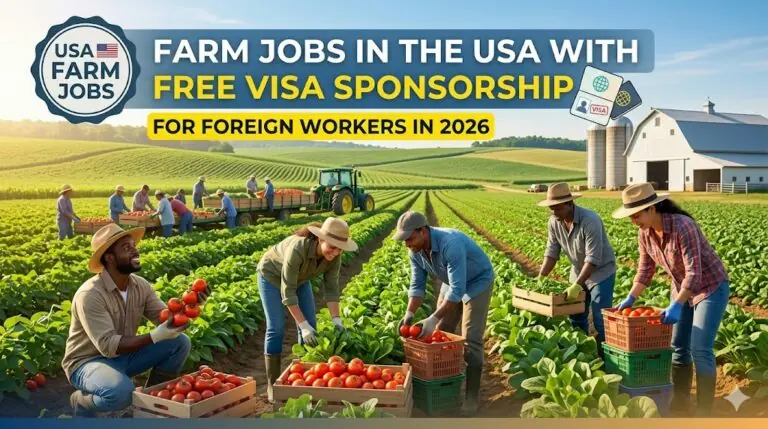
If speed is your priority, the H-2A agricultural visa program is the fastest legal route to authorized U.S. work for most immigrants in 2026. Specifically designed for temporary agricultural workers, the H-2A program allows U.S. agricultural employers to hire foreign nationals for seasonal or peak-load work when domestic workers are unavailable — with no formal academic qualification required to apply.
Agricultural roles under this program include crop planting and harvesting, irrigation management, livestock care, orchard work, food packing and processing, and farm equipment operation. Large farming estates, orchards, vineyards, and food processing operations across states like California, Florida, Georgia, Washington, and North Carolina are among the most active H-2A employers in the country.
What the H-2A Visa Program Actually Provides
The H-2A program is structured to protect workers as much as employers. Sponsored workers are entitled to the Adverse Effect Wage Rate (AEWR) — a federally mandated minimum wage designed to protect both foreign and domestic agricultural workers. Additionally, most H-2A contracts include employer-provided housing, transportation to and from the job site, and workers compensation insurance coverage. Per diem allowances and piece-rate pay structures apply in many food production and harvesting contracts.
The H-2A visa can serve as a strategic entry point into the U.S. workforce and a legitimate immigration pathway to longer-term opportunities. Many immigrants use seasonal agricultural employment to build an American work history, obtain professional references, improve their English language proficiency, and eventually transition into more stable roles with long-term permanent residency potential. ESL classes and vocational training taken during or after H-2A employment further improve your competitiveness for subsequent sponsorship applications in other sectors.
5. Hospitality and Service Industry Roles — H-2B Visa Sponsorship Through Hotels, Resorts, and Restaurants
The U.S. hospitality industry is one of the largest employers of H-2B Temporary Non-Agricultural Worker Visa holders in the country. Hotels, resorts, cruise lines, restaurants, and seasonal tourist destinations rely heavily on this visa category to fill roles during peak travel periods — particularly summer tourism seasons and the winter holiday period.
Positions available through H-2B sponsorship span a wide range of functions: housekeeping, front desk and guest services, food and beverage service, line cooking, kitchen support, event staffing, resort maintenance, and hotel operations management at entry and mid-level. A formal degree is rarely required — employers value reliability, customer service orientation, attention to detail, and prior hospitality experience above academic credentials.
Which Hospitality Employers Sponsor Foreign Workers?
Major hotel chains including Marriott, Hilton, Hyatt, and IHG have all participated in H-2B sponsorship programs through authorized staffing agencies and directly. Cruise lines operating from U.S. ports, luxury mountain resorts, national park lodges, and large restaurant groups are also consistent H-2B sponsors. Employer-sponsored health insurance and dependent health insurance coverage are offered by larger hospitality employers as part of competitive packages that also include housing assistance and transportation allowance in some resort and remote-location contracts.
The key is timing — most H-2B sponsorship applications are filed months in advance of peak seasons, so early preparation and engagement with authorized staffing agencies is essential. Candidates who are geographically flexible, have a documented background in hospitality service, and hold relevant certifications — such as food handler permits, ServSafe certification, or customer service training credentials — position themselves significantly ahead of the competition. Understanding visa application and visa interview requirements in advance further streamlines the process once an employer extends a sponsorship offer.
How to Secure Employer-Sponsored Visa Jobs in the U.S. Without a Degree
Understanding which jobs qualify for sponsorship is only part of the equation. Here is how to actually convert that knowledge into a sponsored job offer and a U.S. work visa in 2026:
Search only verified sponsoring employers. Focus your job search on companies with documented histories of H-2B, H-2A, or EB-3 sponsorship. Check the U.S. Department of Labor’s Foreign Labor Certification (FLC) Data Center, review company career pages directly, and work with licensed immigration-authorized staffing agencies rather than relying solely on general job boards.
Lead with certifications, not degrees. For every role in this guide, certifications carry enormous weight. A forklift license, CNA credential, OSHA certification, NCCER trade certification, or ServSafe permit can be the difference between being overlooked and receiving a job offer with visa sponsorship attached. Credential evaluation through World Education Services (WES) or Educational Credential Evaluators (ECE) ensures your foreign qualifications are recognized by U.S. employers. Invest in these before applying.
Prepare your documentation in advance. Visa sponsorship applications require comprehensive documentation of your work history, training records, professional references, and identity documents. Understanding the difference between consular processing and adjustment of status, and knowing your priority date status for EB-3 applications, allows you to anticipate timelines accurately. Delays in documentation are one of the most common reasons sponsorship applications stall — have everything organized and certified before you begin employer outreach.
Demonstrate cultural adaptability and reliability. U.S. employers who sponsor foreign workers are making a significant financial and administrative investment — visa sponsorship costs can reach several thousand dollars per applicant. They need to be confident that you will integrate smoothly, meet performance expectations, and remain with the company long enough to justify that investment. Emphasize your reliability, your English language proficiency, and your willingness to relocate or adapt to U.S. workplace culture.
Use official government resources, not third-party visa brokers. Navigate the U.S. visa sponsorship process using official sources: the U.S. Department of State’s work visa information portal, the Department of Labor’s H-2B and H-2A program overviews, and USCIS’s EB-3 visa guidance. These resources are free, accurate, and protect you from the widespread scams that target immigrants seeking jobs in USA for foreigners.
Final Thoughts: Building a U.S. Career Through Employer-Sponsored Visa Programs
The path to legal U.S. employment does not always run through a university. For immigrants with practical skills, professional experience, and the right certifications, the sectors covered in this guide — warehousing and logistics, healthcare support, construction and skilled trades, agriculture, and hospitality — offer some of the most direct and legitimate routes to H-2B, H-2A, and EB-3 visa sponsorship available in 2026.
The employers in these fields are not sponsoring foreign workers out of generosity — they are doing it because they genuinely cannot find enough qualified domestic candidates. That structural labor shortage is your strategic opportunity. Position yourself as the solution to a specific employer’s specific staffing problem, back it up with the right credentials and documentation, and you put yourself in the best possible position to receive a sponsored job offer that changes the trajectory of your career — and your long-term opportunities in America.
For immigrants who eventually build financial stability in the U.S., understanding pathways to wealth building — including 401(k) contributions, index funds, Roth IRA accounts, real estate investment, rental property ownership, and retirement planning — becomes an important next step after securing legal employment. The cost of living USA varies significantly by state and city, so factoring in take-home pay after federal income tax, Social Security tax, Medicare tax, and state income tax is essential for financial planning once you arrive.
This article is for informational purposes only and does not constitute legal, immigration, or financial advice. Visa regulations and salary ranges are subject to change. Always consult a licensed U.S. immigration attorney (USCIS-accredited representative) before making any immigration decisions.