Salary ranges and package values cited in this guide reflect industry data and vary based on experience, location, certifications, and employer. Individual results will differ.
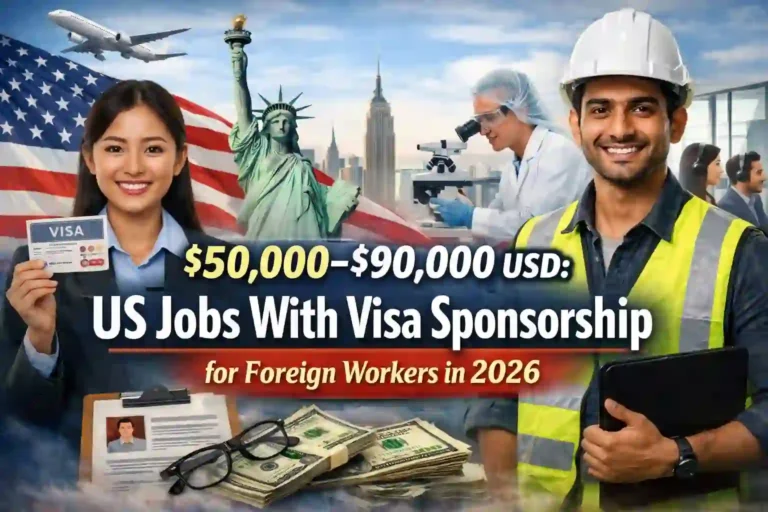
The United States is actively hiring foreign workers in 2026. Across construction sites, agricultural operations, and commercial trucking, American employers are filing visa sponsorship petitions for qualified international candidates who are willing to work, relocate, and build a career in the US. These are not speculative opportunities — they are structured, legally governed hiring pathways that thousands of foreign workers successfully navigate every year.
If you are searching for high paying jobs USA that come with employer-backed legal status, this guide covers the jobs, the visa pathways, the salaries, the certifications, and the exact steps you need to take to position yourself as a competitive candidate for US employer sponsorship in 2026.
Why US Employers Are Sponsoring Foreign Workers in 2026
The US labor market continues to face persistent shortages in skilled trades, agricultural labor, and commercial driving. Domestic worker supply has not kept pace with demand in these sectors, and employers who need to keep operations running have turned to international recruitment as a structural solution — not a temporary measure.
For foreign workers, this creates a genuine window. Employers in these sectors are not sponsoring because they want to — they are sponsoring because they need to. That supply-demand gap is your leverage as an international candidate pursuing jobs in USA for foreigners.
The visa pathways that govern this hiring are well-established. The H-2B Temporary Non-Agricultural Worker Visa covers construction and other non-agricultural roles. The H-2A visa covers seasonal agricultural work. The EB-3 Employment-Based Green Card covers permanent, full-time positions across multiple industries. Each has its own eligibility requirements, application process, and timeline — all of which this guide covers in detail.
Part One: Construction Jobs USA With Visa Sponsorship
What the Market Looks Like in 2026
Construction is one of the most active sectors for foreign worker sponsorship in the United States. Infrastructure spending, residential development, and commercial construction have all expanded significantly, and the construction worker shortage across the US has pushed employers to recruit internationally at a scale not seen in previous decades.
The roles in highest demand for sponsored foreign workers span every level of the industry — from entry-level to senior management:
- General laborers jobs — site preparation, material handling, and support functions
- Apprentice jobs — structured entry-level trade training positions across electrical, plumbing, carpentry, and welding disciplines
- Journeyman jobs — fully qualified tradespeople working independently in their licensed discipline
- Master tradesperson jobs — senior-level trade professionals eligible to supervise and certify work in their discipline
- Electricians jobs — commercial and industrial electrical installation and maintenance
- Plumbers and Pipefitters jobs — residential, commercial, and industrial plumbing systems
- Welders jobs — structural, pipeline, and specialty welding across multiple industries
- Carpenters jobs — framing, finishing, and formwork across residential and commercial projects
- Heavy Equipment Operators jobs — excavators, bulldozers, cranes, and graders
- Crane operator jobs — lifting and rigging operations on major construction projects
- Pipeline welder jobs — high-demand specialty welding for oil, gas, and water infrastructure
- Civil engineers jobs and Structural engineers jobs — design, oversight, and project delivery
- Architects jobs — building design, planning, and construction documentation
- Site supervisor jobs — coordination of crews and daily site operations
- Construction Managers jobs and Project managers jobs — site leadership and operational management
- Construction director jobs — executive-level oversight of multiple projects and regional operations
This range means that whether you are entering the industry as a general laborer, progressing from apprentice to journeyman, or operating at master tradesperson level, there is a sponsored position available at your level in 2026.
What Construction Jobs Pay in 2026
Compensation for sponsored construction workers reflects a $55,000–$120,000 annual salary range depending on role, location, and experience. Realistic benchmarks by position:
| Role | Annual Salary Range |
|---|---|
| General Laborers | $38,000–$55,000 |
| Apprentice (trade-dependent) | $35,000–$55,000 |
| Journeyman (trade-dependent) | $55,000–$80,000 |
| Master Tradesperson | $70,000–$105,000 |
| Carpenters | $50,000–$75,000 |
| Electricians | $60,000–$95,000 |
| Plumbers and Pipefitters | $58,000–$90,000 |
| Welders | $50,000–$85,000 |
| Pipeline Welders | $65,000–$110,000 |
| Heavy Equipment Operators | $55,000–$85,000 |
| Crane Operators | $65,000–$105,000 |
| Civil Engineers | $75,000–$110,000 |
| Structural Engineers | $80,000–$120,000 |
| Architects | $75,000–$115,000 |
| Site Supervisors | $65,000–$90,000 |
| Construction Managers | $85,000–$130,000 |
| Project Managers | $80,000–$125,000 |
| Construction Directors | $100,000–$160,000 |
Beyond base salary, construction employers offering visa sponsorship typically provide relocation packages that cover flights, temporary housing, and a settling-in allowance for the first weeks in the US. Many include a sign-on bonus ranging from $1,000–$10,000 for hard-to-fill trade roles. Overtime pay is standard in construction — most site workers regularly earn 10–20 additional hours per week during peak project phases, which meaningfully increases take-home pay above the base figures above.
Full benefits packages typically include employer-sponsored health insurance valued at $8,000–$15,000 annually, a family health insurance plan covering spouse and children, workers compensation insurance, 401(k) matching contributions, and per diem allowances for workers assigned to projects away from their home base.
The H-2B Visa: Construction Sponsorship Pathway
The H-2B Temporary Non-Agricultural Worker Visa is the primary visa pathway for foreign construction workers coming to the US on a temporary basis.
Annual cap: 66,000 H-2B visas per fiscal year, split equally between the first and second halves. Congress has authorized supplemental allocations in recent years when the cap was exhausted early — which has happened consistently.
Duration: Initial period of up to one year, extendable in one-year increments to a maximum of three years.
Employer requirement: Your employer must demonstrate that there are not enough US workers available to fill the position — a process comparable in principle to PERM labor certification for green card cases.
Process:
- Employer files a temporary labor certification application with the Department of Labor
- DOL certifies the application
- Employer files Form I-129 with USCIS
- If approved, you attend a visa interview at the US Embassy in your country
- Visa is issued and you travel to the US through your designated port of entry
English language proficiency is not a formal requirement for H-2B construction visas, but basic communication ability is expected on active job sites for safety compliance. If your English needs strengthening before you travel, invest in ESL classes or structured language training — US construction sites are safety-critical environments where clear communication directly affects your employability and advancement.
Permanent Pathway: EB-3 Green Card for Construction Workers
For construction workers seeking long-term US residence rather than temporary employment, the EB-3 Employment-Based Green Card is the permanent residency pathway. The process involves:
- PERM labor certification — employer conducts recruitment and demonstrates no qualified US workers are available
- I-140 petition filed with USCIS
- Priority date assigned and tracked against the monthly Visa Bulletin
- Adjustment of status filed using Form I-485 when your priority date becomes current, or consular processing if you are abroad
For most nationalities outside India and China, EB-3 green card priority date wait times are manageable — typically 1–4 years. Approval grants permanent residency USA and a green card. After five years of permanent residency you become eligible for U.S. citizenship and a U.S. passport with visa-free travel to over 180 countries.
Certifications That Maximize Your Chances
US construction employers value verifiable credentials above almost everything else. These are the certifications that most directly affect your employability and sponsorship prospects:
OSHA certifications are the baseline requirement for any US construction site. The OSHA 10-hour construction certification is the minimum. The OSHA 30-hour certification is expected for supervisory roles. Both can be completed online from outside the US before you travel.
NCCER certifications validate trade competency across carpentry, electrical, plumbing, welding, and heavy equipment disciplines. NCCER is the nationally recognized standard across US construction employers and carries significant weight with hiring managers evaluating international candidates.
AWS welding certifications are the US industry standard for welders. If you are applying for welding roles — particularly pipeline welder jobs — AWS certification is close to mandatory with major US employers.
NCCCO crane operator certification is required by most US employers before a foreign crane operator can legally operate lifting equipment on a US job site.
PMP — Project Management Professional is the global standard for project management. For construction project managers and site supervisors, PMP dramatically improves both starting salary and sponsorship attractiveness.
Certified Construction Manager (CCM) is the advanced credential for senior construction management and director-level positions.
LEED Accredited Professional is relevant for green building, sustainable construction, and commercial development roles where environmental compliance is a client requirement.
Vocational training credentials from accredited institutions in your home country — particularly in electrical, plumbing, or welding — are recognized by US employers when supported by a formal credential evaluation from World Education Services (WES) or Educational Credential Evaluators (ECE). Obtain this evaluation before applying. USCIS and US employers require it to confirm the equivalency of your foreign qualifications.
Part Two: Farm Jobs With Visa Sponsorship USA
Agricultural Labor Demand in 2026
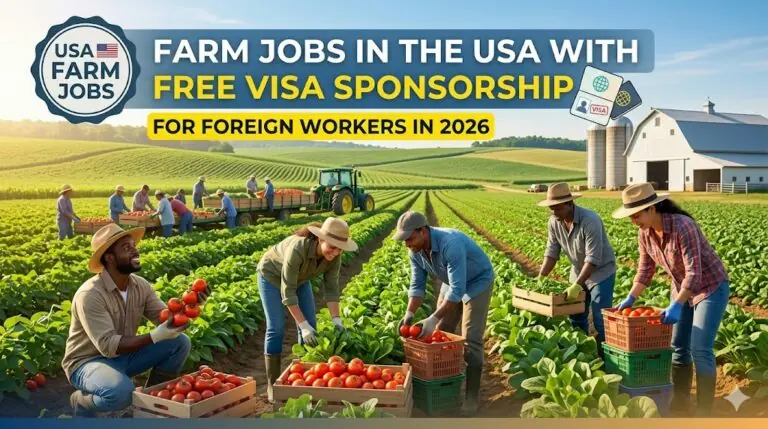
American agriculture depends heavily on foreign labor. Farms, orchards, ranches, and food processing operations across the country rely on international workers for both seasonal and year-round operations. In 2026, agricultural visa sponsorship through the H-2A program remains one of the most accessible and fastest-moving pathways for foreign workers to enter the US labor market legally — with no annual cap, no lottery, and no degree requirement.
Roles commonly available with agricultural visa sponsorship include crop harvest workers, livestock handlers and ranch hands, greenhouse and nursery workers, irrigation and equipment operators, farm supervisors and crew leaders, food processing and packing plant workers, dairy farm workers, and poultry and egg production workers.
For workers coming from agricultural backgrounds, these roles represent a direct transfer of existing skills into a high-paying US employment context — no complex credentialing required and no visa sponsorship costs to the worker.
What Farm Jobs Pay in 2026
Agricultural wages under H-2A are governed by the Adverse Effect Wage Rate (AEWR), a federally mandated minimum updated annually. In 2026, AEWR rates across major agricultural states range from approximately $14.50 to $19.75 per hour.
| Role | Annual Earnings |
|---|---|
| Entry-level harvest workers | $30,000–$40,000 |
| Equipment operators | $38,000–$55,000 |
| Crew leaders and supervisors | $45,000–$65,000 |
| Specialized livestock and dairy workers | $40,000–$60,000 |
Beyond wages, H-2A employers are legally required to provide housing assistance — free employer-provided accommodation for the full duration of the contract — along with a transportation allowance covering travel from your home country to the worksite and back. Workers compensation insurance is mandatory, and a three-quarters work guarantee ensures you are paid for at least 75% of the contract workdays whether or not the work is operationally available.
When housing assistance and transportation allowance are factored in, the total package for a harvest worker earning $16/hour can represent $45,000–$55,000 in combined wages and benefits annually.
The H-2A Visa: Agricultural Sponsorship Pathway
The H-2A Temporary Agricultural Worker visa has no annual cap. There is no lottery, no numerical limit, and no queue. If your employer’s application is approved and you are eligible, you receive the visa.
Duration: Tied to the agricultural contract — typically 3 to 10 months for seasonal work, up to 3 years for year-round operations.
Process:
- US employer files a job order with the State Workforce Agency and submits a temporary labor certification application to the Department of Labor at least 60 days before the work start date
- DOL certifies the application
- Employer files Form I-129 with USCIS
- You apply for the H-2A visa at the US Embassy in your country and attend a visa interview
- Visa is issued and you travel to the US
Critical warning: H-2A fraud is widespread internationally. Legitimate H-2A employers never charge workers recruitment fees. All legitimate visa sponsorship costs — government filing fees, transportation, housing — are either paid directly by the employer or reimbursed on arrival. Any recruiter demanding upfront payment is running a scam.
Part Three: Driving Jobs USA With Visa Sponsorship
Commercial Driving Demand in 2026
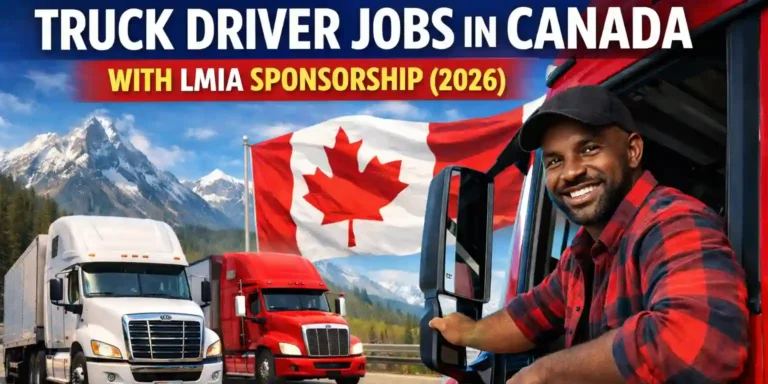
The US trucking and commercial transportation industry faces a structural driver shortage that has deepened through 2026. Large trucking companies, logistics operators, and warehousing firms have increasingly turned to foreign worker sponsorship to fill the gap — making commercial driving one of the most accessible trade jobs America offers to international candidates.
The primary credential — a Commercial Driver’s License (CDL-A) — is skills-based, not academic. If you can pass the CDL tests and meet the physical requirements, you qualify regardless of your educational background.
Driving roles available with visa sponsorship include long-haul OTR truck drivers, regional route drivers, local delivery and shuttle drivers, flatbed and specialized freight drivers, tanker and hazmat drivers, dump truck and construction transport drivers, crane operator transport roles, and pipeline welder positions requiring multi-site travel.
What Driving Jobs Pay in 2026
| Role | Annual Earnings |
|---|---|
| Local/Shuttle Driver | $45,000–$65,000 |
| Regional Driver | $60,000–$80,000 |
| OTR Long-Haul Driver | $65,000–$95,000 |
| Flatbed Specialist | $65,000–$90,000 |
| Tanker Driver | $70,000–$100,000 |
| Owner-Operator (leased) | $80,000–$150,000+ |
Large trucking companies sponsoring foreign drivers typically offer relocation packages covering flights and initial accommodation, sign-on bonus payments of $5,000–$15,000, health insurance and dependent health insurance for immediate family members, 401(k) matching contributions, and overtime pay for qualifying hours. Per diem allowances are standard for OTR drivers — paid as a tax-free per diem rate on top of base mileage pay, which meaningfully reduces federal income tax burden while increasing effective take-home pay.
Visa Pathways for Foreign Drivers
The H-2B Temporary Non-Agricultural Worker Visa is the most common pathway for foreign commercial drivers entering the US on a temporary basis. Your employer files the petition, DOL certifies, USCIS approves, and you attend a visa interview at the nearest US Embassy.
For permanent driving positions, EB-3 green card sponsorship is available through the same PERM labor certification and I-140 petition process described in Part One. This is the immigration pathway that leads to full permanent residency USA.
The TN Visa is available only to Canadian and Mexican nationals under the USMCA trade agreement and does not apply to workers outside North America.
CDL Licensing for Foreign Workers: You cannot legally operate a commercial vehicle in the US on a foreign license. Once you arrive, you must obtain a US CDL-A through the state where you are domiciled. Most foreign drivers with prior commercial experience pass within 4–8 weeks. Most sponsoring employers factor this testing period into their onboarding timeline.
Endorsements That Increase Earning Power
- Hazmat (H endorsement) — requires TSA background check; adds $5,000–$15,000/year to earnings
- Tanker (N endorsement) — required for liquid bulk transport
- Doubles/Triples (T endorsement) — for pulling multiple trailer configurations
- Passenger (P endorsement) — for bus and passenger transport roles
- EPA refrigerant handling certification — relevant for drivers managing refrigerated cargo units
The Complete Application Roadmap: Step by Step
Step 1 — Identify your target role and visa category Be specific. Are you pursuing H-2B construction work, H-2A agricultural work, or EB-3 permanent employment? Each has different timelines, requirements, and employer obligations. Clarity here prevents wasted effort and misdirected applications.
Step 2 — Build your document package Gather the following before contacting any employer:
- Valid passport with minimum 6 months validity beyond your intended US stay
- Educational certificates and transcripts
- Credential evaluation from WES or ECE if your qualifications are from outside the US
- Trade certifications — OSHA, NCCER, AWS, NCCCO, PMP, CCM, or LEED as applicable
- Vocational training certificates from accredited institutions
- Employment history documentation
- English language proficiency evidence if required by your consular post
- Official driving record from your home country’s licensing authority if applying for driving roles
Step 3 — Target employers with a proven sponsorship track record Focus your applications on companies that have filed H-2B or H-2A petitions in previous years — DOL records are public and searchable. Large construction firms, agricultural operations, and trucking companies with established HR and immigration infrastructure are your primary targets. Staffing agencies specializing in H-2B or H-2A placement are also valuable intermediaries — they already have DOL relationships and can place you with multiple client employers simultaneously.
Step 4 — Apply and be upfront about sponsorship Do not conceal your need for visa sponsorship. Employers who sponsor understand what is involved. Apply to roles explicitly listed as offering sponsorship. State your qualifications, your visa situation, and your availability clearly in your first communication.
Step 5 — Employer files the petition Once you accept an offer from a sponsoring employer, the immigration process begins on their side. Provide accurate documentation promptly. Delays on your end delay the entire petition timeline.
Step 6 — Visa interview at the US Embassy Bring all documentation organized and complete. Be honest and direct in your answers. Consular officers are assessing whether the job offer is genuine, whether your qualifications are real, and whether you will comply with your visa terms.
Step 7 — Travel and arrival Book travel only after your visa is in hand. At the port of entry, present your passport, visa, and employer documentation to the CBP officer. You will be formally admitted in the visa status matching your petition.
Understanding Your Rights as a Sponsored Worker
Many foreign workers arrive in the US without a clear understanding of their legal protections. This matters:
- Your employer is legally prohibited from confiscating your passport
- Your employer cannot charge you for government filing fees associated with your visa petition — all petition-side visa sponsorship costs are the employer’s legal obligation
- You are entitled to the wage stated in your Labor Condition Application or H-2A job order — not less
- You have the right to change employers under specific conditions without losing your immigration status
- Workers compensation insurance coverage is mandatory — if you are injured on the job, you have a legal right to file a claim
- Liability insurance carried by your employer protects the worksite — it does not substitute for your own workers compensation rights
If any employer violates these protections, the Department of Labor’s Wage and Hour Division handles complaints. You can report violations without jeopardizing your immigration status in most circumstances.
Financial Planning: Building Wealth on a US Income
Earning a US salary is only the first step. The foreign workers who build lasting wealth in America are the ones who understand how the US financial system works and use it deliberately from the moment they arrive.
Understanding Your Deductions
Your gross salary will be reduced by federal income tax (10% to 37% depending on your income bracket), Social Security tax (6.2% on wages up to the annual wage base), Medicare tax (1.45%), and state income tax where applicable. States with zero state income tax — Texas, Florida, Tennessee, Nevada, and Washington — meaningfully increase your take-home pay compared to high-tax states like California or New York. When evaluating job offers in different locations, factor state tax into your real compensation calculation.
Life Insurance: Protecting Your Income and Your Family
Life insurance is one of the most important and most overlooked financial products for sponsored foreign workers in the US. If you are sending money home to family, supporting dependents in the US, or carrying any debt, your income is the financial foundation everyone around you depends on. Life insurance protects that foundation if something happens to you.
Term life insurance provides coverage for a fixed period — typically 10, 20, or 30 years — and pays a death benefit to your named beneficiaries if you die during the coverage term. A healthy 30-year-old can secure $500,000 in term life coverage for $25–$40 per month. This is the most direct way to ensure your family is financially protected regardless of what happens to you.
Whole life insurance combines a death benefit with a cash value savings component that grows on a tax-deferred basis. Premiums are significantly higher than term life, but the policy builds cash value you can borrow against. For long-term wealth building and retirement planning, some financial advisors recommend a combination of term life coverage and whole life accumulation — though this is most relevant after you have maximized your 401(k) and Roth IRA contributions first.
Group life insurance is frequently included in employer benefits packages at no cost to the employee — typically coverage equal to one or two times your annual salary. Accept this automatically. It costs you nothing and provides baseline protection from day one.
As your income grows and your financial obligations increase — mortgage payments, rental property debt, family dependents — revisit your life insurance coverage annually to ensure your protection keeps pace with your liability exposure.
Mortgage and Home Ownership: The Wealth Engine Most Immigrants Ignore
Real estate investment is the single largest wealth-building vehicle available to most US residents, and sponsored workers on H-2B and H-2A visas are legally permitted to purchase property in the United States. You do not need US citizenship or permanent residency to buy a home.
A mortgage is a long-term loan — typically 15 or 30 years — secured against the property you purchase. Instead of paying rent to a landlord and building no equity, mortgage payments build ownership stake in an asset that historically appreciates in value. Key mortgage concepts every sponsored worker should understand:
Credit score is the primary factor that determines your mortgage eligibility and interest rate. When you arrive in the US, you have no US credit history. Build it immediately by opening a secured credit card, using it for small purchases, and paying the full balance every month. After 12–18 months of responsible credit use, you will have a score strong enough to qualify for competitive mortgage rates.
Down payment — Conventional mortgages typically require 10–20% down. FHA loans allow as little as 3.5% for eligible borrowers. On a $250,000 home — realistic in many lower cost of living USA markets where H-2B and H-2A jobs are concentrated — a 10% down payment is $25,000. This is an achievable savings target within 2–3 years for a disciplined sponsored worker earning $55,000–$90,000 annually.
Equity building — Every mortgage payment reduces your loan balance and increases your ownership stake. In appreciating markets, your home’s value rises simultaneously. Many sponsored workers who buy a first home eventually convert it to a rental property when they move, generating passive income while continuing to build net worth.
Personal loans — For sponsored workers who need to bridge a financial gap — covering initial relocation expenses, purchasing a vehicle, or consolidating high-interest debt — US personal loans offer structured borrowing at fixed rates. Interest rates range from 7% to 24% depending on your credit profile. Use personal loans for specific, defined purposes with a clear repayment plan — not as ongoing financial support.
Health Insurance Beyond Employer Coverage
Most sponsored employers provide employer-sponsored health insurance as part of the standard benefits package. But understanding your full options is important — particularly if your employer’s plan does not fully cover your family or if you change jobs during your stay.
Individual health insurance through the federal Health Insurance Marketplace is available to H-2B visa holders. Plans range from catastrophic coverage with low premiums and high deductibles to comprehensive platinum-level plans. Premium costs depend on your income, age, and the plan tier you select.
COBRA continuation coverage — If you lose employer-sponsored coverage due to a job change or layoff, COBRA allows you to continue your existing employer plan for up to 18 months. The cost is higher because you pay both the employee and employer premium portions, but it maintains continuous coverage without a gap.
Supplemental insurance — Many sponsored workers add supplemental policies on top of their base employer plan. Common products include dental and vision insurance, short-term disability insurance that replaces a portion of your income if you are unable to work due to illness or injury, critical illness insurance that pays a lump sum on diagnosis of a major condition such as cancer or heart attack, and accident insurance that provides cash benefits for emergency room visits, hospitalization, and recovery costs following an accident. For workers in physically demanding roles — construction, agriculture, commercial driving — accident insurance and short-term disability insurance are particularly worth considering given the occupational risk profile of these industries.
Auto Insurance: A Legal Requirement, Not an Option
Every driver in the US is legally required to carry minimum liability insurance on any vehicle they operate. Beyond the legal minimum, most financial advisors recommend collision coverage — which pays for damage to your own vehicle in an accident regardless of fault — and comprehensive coverage, which covers non-collision damage including theft, weather, and vandalism. For sponsored workers who finance a vehicle with an auto loan, lenders typically require both collision and comprehensive coverage as a loan condition. Average annual auto insurance costs range from $1,200 to $2,400 depending on your state, driving record, vehicle, and coverage level.
Retirement and Investment: The Long Game
- Contribute to your 401(k) up to the employer match from day one — unclaimed match is forfeited compensation
- Open a Roth IRA once your income and tax situation stabilizes — contributions grow tax-free and qualified withdrawals in retirement are not taxed
- Invest consistently in index funds through a low-cost brokerage account — compounding over 10–20 years is the foundation of serious wealth building
- Monitor your net worth monthly from arrival — tracking assets minus liabilities maintains financial discipline through the expensive early transition period
- Build toward real estate investment once you have established US credit history and savings — owning rental property generates passive income while building long-term equity
- Plan for retirement planning from the start. Your Social Security benefits accrue based on your US earnings history — the more contributing years on record, the higher your eventual benefit
Tax filing: All US income is subject to taxation regardless of visa status. File your federal and state income tax returns annually by the April 15 deadline. H-2B and H-2A workers are typically classified as non-resident aliens for tax purposes in their first years — use Form 1040-NR. Consult a tax professional familiar with non-resident alien taxation during your first filing year.
The Long-Term Picture: From Sponsored Worker to Permanent Resident
The H-2B and H-2A are temporary visas. But they are not dead ends. Here is how the immigration pathway from temporary sponsorship to permanent status works:
Stage 1 — Build your US employment record Work your contract with full commitment. Demonstrate reliability, skill, and safety compliance. Employers who sponsor temporary workers repeatedly are often the same employers willing to convert strong performers to permanent positions.
Stage 2 — Employer begins EB-3 process When your employer decides to sponsor you permanently, they begin PERM labor certification — a formal recruitment process demonstrating that no qualified US worker is available for your position. PERM takes approximately 8–18 months in 2026.
Stage 3 — I-140 petition and priority date After PERM certification, your employer files the I-140 immigrant petition with USCIS. Upon approval, you receive your priority date — your position in the green card queue. For most nationalities, the EB-3 green card queue moves within 1–4 years.
Stage 4 — Adjustment of status or consular processing When your priority date becomes current, you file Form I-485 for adjustment of status if you are in the US, or complete consular processing at a US Embassy if abroad. Approval issues your green card and permanent residency USA.
Stage 5 — Citizenship and beyond After five years as a permanent resident, you qualify for U.S. citizenship and a U.S. passport. Citizenship unlocks federal jobs eligibility, full visa-free travel access, and the permanent right to sponsor family members for their own green card and immigration pathway to the US.
Starting Your Own Business After Permanent Residency
Many immigrants who enter the US on sponsored work visas eventually transition to self-employment or business ownership. Once you have permanent residency, you can register a contracting business USA in your state of residence, obtain a contractor’s license through your state licensing board, and build an independent operation in your trade.
Understanding your business startup costs — entity formation, insurance, bonding, and equipment — from early in your career positions you to make this transition successfully. Build accurate business revenue projections based on local market rates for your trade, manage operating expenses including payroll, materials, vehicle costs, and insurance, and complete business registration with your state and obtain an EIN from the IRS. For construction workers especially, transitioning from sponsored employee to licensed contractor is a well-trodden path that many former H-2B workers have successfully made.
Frequently Asked Questions
Do I need a college degree to get visa sponsorship for these jobs? For H-2B construction and driving roles, and H-2A agricultural roles, no degree is required. Employers care about trade skills, physical capability, and reliability. For engineering, architecture, and management roles, a relevant degree or equivalent documented experience is required and must be supported by a formal credential evaluation from WES or ECE.
Can my family come with me? Dependents of H-2B and H-2A workers can apply for dependent status to accompany you, but these statuses do not include US work authorization. For EB-3 green card holders, you can sponsor family members for their own permanent residency once your green card is approved. Dependent health insurance for your spouse and children is typically included in the benefits packages offered by larger sponsoring employers.
How long does the sponsorship process take? H-2A agricultural: 60–90 days from employer filing to visa issuance in most cases. H-2B construction and driving: 3–6 months under standard processing. EB-3 permanent: 1–5 years depending on nationality and petition volume.
Are there fees I have to pay? Legitimate sponsors cover all government filing fees. You are responsible for your own passport, credential evaluation, ESL classes if needed, and travel to the embassy for your visa interview. Any recruiter or employer demanding upfront payment for visa sponsorship is running a scam.
What is the long-term immigration pathway? H-2B and H-2A are temporary. If your employer converts your position to permanent and sponsors you for an EB-3 green card, you begin the path to permanent residency USA. After five years as a permanent resident, you qualify for U.S. citizenship, a U.S. passport, and the long-term opportunities in America that come with permanent legal status — including visa-free travel to over 180 countries and eligibility to sponsor family members.
What about the LMIA-approved jobs pathway in Canada? For workers considering both the US and Canada simultaneously, Canada’s LMIA-approved jobs process is a comparable employer-driven sponsorship pathway. However, US jobs in construction, farming, and driving consistently offer higher salaries, stronger employer-sponsored health insurance packages, and superior 401(k) and Social Security benefits compared to equivalent Canadian positions. The US remains the stronger choice for maximizing total compensation and long-term wealth building.
The information in this article is for general educational purposes only and does not constitute legal, immigration, or financial advice. Visa regulations, employer sponsorship practices, and wage rates are subject to change. Consult a licensed US immigration attorney for advice specific to your personal situation before making any immigration or employment decisions.