Salary ranges and package values cited reflect industry data and vary based on experience, location, certifications, and employer. Individual results will differ.
Foreign workers are being hired in 2026 at every level of the economy — from agricultural harvest workers earning $40,000 annually to machine learning engineers earning $300,000 in total compensation. The industries are different. The visa pathways are different. The salaries are different. But the underlying reality is the same across all of them: American employers cannot fill critical roles with domestic workers alone, and they are filing visa sponsorship petitions for qualified international candidates at a scale that represents a genuine, structural opportunity for foreign workers willing to pursue it systematically.
This guide covers every industry, every major US visa pathway, every salary range, and every step of the financial planning process for foreign workers building a life in the United States in 2026. Whether you are a farm worker, a truck driver, a construction tradesperson, a registered nurse, a software engineer, or a structural engineer, your pathway to legal US employment with employer-paid visa sponsorship is documented here in full.
US Employers Are Sponsoring Foreign Workers in 2026
The US labor market faces documented, persistent shortages across agriculture, construction, transportation, healthcare, technology, and engineering. These are not cyclical gaps that close when the economy slows — they are structural deficits driven by demographic change, educational pipeline inadequacy, and accelerating demand from legislative investment.
The Infrastructure Investment and Jobs Act has committed more than $1.2 trillion to roads, bridges, water systems, energy infrastructure, and broadband — creating sustained multi-year demand for construction workers, civil engineers, electricians, plumbers, and heavy equipment operators that the domestic workforce cannot supply at the required volume.
The CHIPS and Science Act has committed more than $280 billion to semiconductor manufacturing and STEM workforce development — creating acute demand for semiconductor engineers, process engineers, and advanced manufacturing specialists in new fabrication facilities being built across Arizona, Ohio, and Texas.
In healthcare, an aging population and a retiring clinician workforce have created Health Professional Shortage Areas (HPSAs) across all 50 states — driving aggressive international recruitment for physicians, registered nurses, and allied health professionals at levels not seen in previous decades.
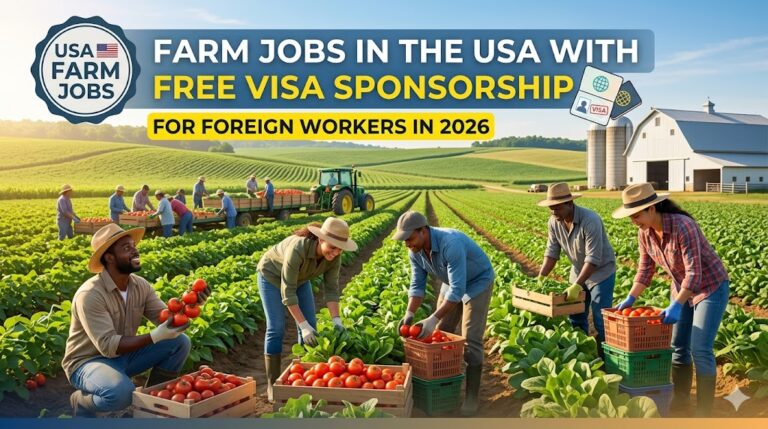
In agriculture, American farms, orchards, and food processing operations have depended on foreign labor for generations. In 2026, H-2A agricultural sponsorship continues at record levels — with no annual cap, no lottery, and processing times as short as 60 days from employer filing to visa issuance.
In technology, the emergence of artificial intelligence, generative AI, and large language models has created entirely new job categories faster than domestic universities can produce graduates — and companies are responding with aggressive international sponsorship across software engineering, machine learning, cloud architecture, and cybersecurity.
Across all of these sectors, the mechanism is the same: US employers file visa petitions on your behalf, pay the government filing fees, and take legal responsibility for your employment status in the United States. You provide the qualifications, the documentation, and the commitment to show up and perform. The opportunity is real. The competition is high. And the workers who approach it systematically — with the right visa category, the right documentation, and the right employers targeted — are the ones who succeed.
The Complete US Work Visa Menu for 2026
Understanding which visa category applies to your situation is the first and most consequential decision in the entire process. Here is every major pathway:
| Visa | Who It Is For | Key Feature |
|---|---|---|
| H-2A | Seasonal agricultural workers | No cap, no lottery, fastest processing |
| H-2B Temporary Non-Agricultural Worker Visa | Construction, hospitality, driving, non-agricultural roles | 66,000 annual cap, employer-filed |
| H-1B Specialty Occupation Visa | Degree-required specialty occupations — tech, engineering, healthcare, finance | 85,000 annual cap, lottery |
| H-1B1 | Chilean and Singaporean nationals in specialty occupations | No lottery, direct filing |
| O-1 | Extraordinary ability in sciences, arts, business, athletics | No cap, no lottery |
| L-1A | Intracompany transfer — executives and managers | No cap, leads to EB-1C green card |
| L-1B | Intracompany transfer — specialized knowledge workers | No cap |
| TN Visa | Canadian and Mexican nationals — USMCA professionals | No cap, renewable indefinitely |
| E-3 | Australian nationals in specialty occupations | 10,500 cap, rarely exhausted |
| J-1 | Exchange visitors — research, teaching, medical training | Program-sponsor dependent |
| F-1 / OPT / STEM OPT | International students — post-graduation work authorization | 12 + 24 months work authorization |
| EB-1A | Extraordinary ability — self-petition, no employer required | No PERM, priority dates current |
| EB-1B | Outstanding professors and researchers | No PERM required |
| EB-1C | Multinational managers and executives | Requires prior L-1 |
| EB-2 green card | Advanced degree professionals | PERM required unless NIW |
| EB-3 Employment-Based Green Card | Skilled workers and professionals across all industries | PERM required |
| NIW — National Interest Waiver | Researchers, scientists, physicians in shortage areas | Self-petition, no PERM, no employer |
| USMCA / TN | Canadian and Mexican trade professionals | Port of entry application for Canadians |
Part One: Farm Jobs in the USA With Visa Sponsorship
American agriculture is one of the most accessible entry points into legal US employment for foreign workers. The H-2A agricultural visa program has no annual cap, no lottery, and no educational requirement. If your employer’s application is approved and you are eligible, you receive the visa — no waiting list, no random selection.
Roles Available With Agricultural Visa Sponsorship
Crop harvest workers, livestock handlers, ranch hands, greenhouse and nursery workers, irrigation and equipment operators, farm supervisors, crew leaders, food processing workers, dairy farm workers, and poultry production workers are all actively recruited through H-2A sponsorship in 2026. States with the highest H-2A activity include Florida, Georgia, North Carolina, California, Washington, and Texas.
What Farm Jobs Pay in 2026
Agricultural wages under H-2A are set at or above the federal Adverse Effect Wage Rate — a state-by-state minimum updated annually. In 2026, hourly rates across major agricultural states range from approximately $14.50 to $19.75 per hour.
| Role | Annual Earnings |
|---|---|
| Entry-level harvest worker | $30,000–$40,000 |
| Equipment operator | $38,000–$55,000 |
| Crew leader / supervisor | $45,000–$65,000 |
| Livestock and dairy specialist | $40,000–$60,000 |
Beyond wages, H-2A employers are legally required to provide free housing assistance for the full contract duration, a transportation allowance covering travel from your home country to the worksite and back, and workers compensation insurance covering all on-the-job injuries. A three-quarters work guarantee ensures you are paid for at least 75% of your contract workdays regardless of operational availability.
When housing assistance and transportation allowance are factored in, the effective total package for a harvest worker can represent $45,000–$55,000 in combined wages and benefits annually.
How to Find H-2A Sponsored Farm Jobs
All H-2A job orders are publicly listed through the Department of Labor’s Foreign Labor Application Gateway. Legitimate H-2A employers never charge recruitment fees. Any agent or recruiter demanding payment to secure an H-2A position is operating a scam — report them and disengage immediately.
For a complete step-by-step guide to farm job visa sponsorship including the full H-2A application process, visit our dedicated guide: Farm Jobs in the USA With Free Visa Sponsorship for Foreign Workers in 2026.
Part Two: Construction Jobs USA With Visa Sponsorship
Construction is one of the most active sectors for H-2B visa sponsorship in 2026. The construction worker shortage across the US — deepened by Infrastructure Act spending — has pushed employers to recruit internationally at a scale that represents a genuine and sustained opportunity for skilled foreign tradespeople.
Roles Available With Construction Visa Sponsorship
Roles actively sponsored include general laborers, apprentices, journeymen, master tradespeople, electricians, plumbers and pipefitters, carpenters, welders, pipeline welders, heavy equipment operators, crane operators, civil engineers, structural engineers, architects, site supervisors, construction managers, project managers, and construction directors.
What Construction Jobs Pay in 2026
| Role | Annual Salary Range |
|---|---|
| General Laborers | $38,000–$55,000 |
| Apprentice | $35,000–$55,000 |
| Journeyman | $55,000–$80,000 |
| Master Tradesperson | $70,000–$105,000 |
| Electricians | $60,000–$95,000 |
| Plumbers and Pipefitters | $58,000–$90,000 |
| Welders / Pipeline Welders | $55,000–$110,000 |
| Heavy Equipment Operators | $55,000–$85,000 |
| Crane Operators | $65,000–$105,000 |
| Civil / Structural Engineers | $75,000–$120,000 |
| Construction Managers | $85,000–$130,000 |
| Project Managers | $80,000–$125,000 |
| Construction Directors | $100,000–$160,000 |
Employers offering visa sponsorship in construction typically provide relocation packages covering flights and temporary housing, a settling-in allowance for the first weeks in the US, a sign-on bonus of $1,000–$10,000 for hard-to-fill roles, overtime pay adding 10–20 additional hours weekly during peak project phases, employer-sponsored health insurance valued at $8,000–$15,000 annually, a family health insurance plan covering dependents, workers compensation insurance, 401(k) matching contributions, and per diem allowances for workers assigned to out-of-area projects.
Certifications That Maximize Your Sponsorship Prospects
OSHA certifications — 10-hour or 30-hour construction — are the baseline for any US construction site and can be completed online before you travel. NCCER certifications validate trade competency across electrical, plumbing, carpentry, and welding disciplines. AWS welding certifications are the US industry standard for welders. NCCCO crane operator certification is required by most US employers for crane operation. PMP — Project Management Professional and Certified Construction Manager (CCM) credentials strengthen management-level sponsorship cases significantly.
Vocational training credentials from outside the US must be supported by a credential evaluation from World Education Services (WES) or Educational Credential Evaluators (ECE) before USCIS or US employers will recognize them.
For a complete guide to construction visa sponsorship including the H-2B process, EB-3 green card pathway, and PERM labor certification timeline, visit: US Construction Jobs With Visa Sponsorship 2026.
Part Three: Driving Jobs USA With Visa Sponsorship
The US trucking and commercial transportation industry faces a structural driver shortage that has deepened through 2026. Commercial driving jobs in America are among the most accessible for foreign workers because the primary credential — a Commercial Driver’s License (CDL-A) — is skills-based rather than academic.
Roles Available With Driving Visa Sponsorship
Long-haul OTR truck drivers, regional route drivers, local delivery and shuttle drivers, flatbed and specialized freight drivers, tanker and hazmat drivers, dump truck operators, and construction transport drivers are all actively sponsored through H-2B petitions in 2026.
What Driving Jobs Pay in 2026
| Role | Annual Earnings |
|---|---|
| Local / Shuttle Driver | $45,000–$65,000 |
| Regional Driver | $60,000–$80,000 |
| OTR Long-Haul Driver | $65,000–$95,000 |
| Flatbed Specialist | $65,000–$90,000 |
| Tanker Driver | $70,000–$100,000 |
| Owner-Operator (leased) | $80,000–$150,000+ |
Large trucking companies sponsoring foreign drivers typically provide relocation packages, sign-on bonus payments of $5,000–$15,000, health insurance and dependent health insurance, 401(k) matching contributions, and overtime pay for qualifying hours. Per diem allowances — paid as a tax-free rate on top of base mileage — meaningfully reduce federal income tax burden while increasing effective take-home pay.
CDL Licensing for Foreign Workers
You cannot legally operate a commercial vehicle in the US on a foreign license. Once you arrive in the US, you must obtain a CDL-A through the state where you are domiciled. Most foreign drivers with prior commercial experience pass the knowledge and skills tests within 4–8 weeks. Most sponsoring employers factor this testing period into the onboarding timeline and begin paying your wage from arrival — not from the date of CDL issuance.
Endorsements that increase earning power include Hazmat (adds $5,000–$15,000/year), Tanker, Doubles/Triples, Passenger, and EPA refrigerant handling certification for drivers managing refrigerated cargo systems.
Part Four: Hotel and Hospitality Jobs USA With Visa Sponsorship
The US hospitality industry sponsors foreign workers extensively through the H-2B program for roles in hotels, resorts, restaurants, and event facilities. Seasonal resort operations — ski resorts in winter, beach resorts in summer — are among the highest-volume H-2B filers in the country.
Roles Available With Hospitality Visa Sponsorship
Hotel front desk agents, housekeeping staff, restaurant servers and kitchen workers, resort activity coordinators, concierge professionals, food and beverage managers, executive chefs, hotel general managers, and event coordinators are all sponsored through H-2B and in some cases H-1B pathways depending on the role’s educational requirements.
What Hospitality Jobs Pay in 2026
| Role | Annual Earnings |
|---|---|
| Housekeeping / Entry-level | $30,000–$45,000 |
| Front Desk / Guest Services | $35,000–$55,000 |
| Restaurant Server (with tips) | $40,000–$70,000 |
| Executive Chef | $65,000–$95,000 |
| Food and Beverage Manager | $55,000–$85,000 |
| Hotel General Manager | $80,000–$140,000 |
Hospitality employers in resort markets frequently provide housing assistance and transportation allowance as part of the sponsorship package — particularly for seasonal positions in remote locations. Health insurance and workers compensation insurance are standard at major hotel chains and resort operators.
Part Five: What Your US Salary Actually Gets You — Cost of Living in America
Before you calculate how much money you will send home or how fast you will save, you need to understand what your US salary actually costs to live on. The United States is not one economy — it is dozens of regional economies with dramatically different costs for rent, food, transportation, and healthcare. Your $65,000 trucking salary in Texas and your $65,000 nursing salary in New York represent fundamentally different financial situations.
Rent: The Biggest Variable in Your Budget
Rent is the single largest monthly expense for most sponsored workers, and it varies more than any other cost.
| City / Region | Average 1-Bedroom Monthly Rent |
|---|---|
| Houston, Texas | $1,100–$1,500 |
| Dallas, Texas | $1,200–$1,600 |
| Charlotte, North Carolina | $1,200–$1,600 |
| Atlanta, Georgia | $1,300–$1,800 |
| Chicago, Illinois | $1,500–$2,200 |
| Miami, Florida | $1,800–$2,600 |
| Washington D.C. | $2,000–$2,800 |
| Los Angeles, California | $2,200–$3,200 |
| New York City, New York | $2,800–$4,000 |
| San Francisco, California | $3,000–$4,500 |
For workers targeting farm jobs or construction roles, housing assistance is legally required under H-2A contracts and frequently provided by H-2B construction sponsors — meaning your effective take-home is significantly higher than workers paying market rent from day one.
States With No Income Tax — More Money in Your Pocket
Your federal income tax is the same regardless of where you live. But state income tax varies dramatically — and in several major employment states, it is zero.
States with no state income tax: Texas, Florida, Nevada, Washington, Tennessee, Wyoming, South Dakota. Workers in these states keep approximately 3%–9% more of their gross income compared to high-tax states like California (up to 13.3% state rate) and New York (up to 10.9% state rate).
If you have flexibility in which region you target for employment, this is a factor worth calculating. A $70,000 driving salary in Texas produces meaningfully higher take-home than the same salary in California once state income tax is deducted.
What a Realistic Monthly Budget Looks Like
Here is what a sponsored worker earning $55,000–$70,000 annually can realistically expect as a monthly financial picture in a mid-cost city like Houston, Dallas, Charlotte, or Atlanta:
| Item | Monthly Cost (Estimate) |
|---|---|
| Rent (1-bedroom) | $1,200–$1,600 |
| Groceries | $300–$500 |
| Transportation (car payment + insurance) | $400–$700 |
| Utilities (electricity, water, internet) | $150–$250 |
| Phone | $50–$100 |
| Health insurance (employee portion) | $100–$250 |
| Miscellaneous | $200–$400 |
| Total Monthly Expenses | $2,400–$3,800 |
On a $60,000 annual salary, your monthly take-home after federal and state taxes in a no-tax state is approximately $4,000–$4,300. After expenses, a disciplined worker in a mid-cost city is left with $500–$1,500 per month for savings, remittances, and wealth building — before any overtime, bonuses, or housing benefits that reduce your rent cost.
Workers earning $90,000–$110,000 in healthcare, engineering, or senior trades roles can realistically accumulate $1,500–$2,500 per month in savings while living comfortably — particularly in Texas, Florida, and the Southeast.
Part Six: Healthcare and Nursing Jobs USA With Visa Sponsorship
Healthcare is in a sponsorship category of its own in 2026. Health Professional Shortage Areas exist across all 50 states, and hospital systems, medical groups, and healthcare networks are recruiting internationally at unprecedented levels for both nursing and physician roles.
Registered Nurses
Foreign-trained registered nurses must pass the NCLEX — the National Council Licensure Examination — before practicing in the US. Credential evaluation through a CGFNS-approved agency and a state nursing license are also required. EB-3 Employment-Based Green Card sponsorship is the primary permanent pathway for internationally recruited nurses, and many large hospital systems sponsor nurses directly through this category.
Registered nurse salary range: $65,000–$110,000 annually, with significant premiums for ICU, operating room, and emergency nursing specialties. Experienced ICU nurses in California earn $130,000–$150,000 annually between base pay and shift differentials.
Physicians
Foreign-trained physicians must obtain ECFMG certification, pass all three steps of the USMLE, and complete an accredited US residency program before independent practice. Physicians who serve in Health Professional Shortage Areas are eligible for J-1 waiver and Conrad 30 waiver programs that remove the two-year home residency requirement in exchange for shortage area service.
Physician salary range: $200,000–$600,000+ depending on specialty and location.
Benefits packages for sponsored healthcare workers typically include employer-sponsored health insurance, family health insurance plan coverage, dependent health insurance, 401(k) matching contributions, continuing education allowances, and — for physicians — employer-paid malpractice insurance or malpractice premium reimbursement.
For a complete guide to nursing visa sponsorship including the NCLEX process, EB-3 green card pathway, and state licensing requirements, visit: Nursing Jobs in Canada and the USA With Visa Sponsorship.
Part Seven: Technology, Engineering, and Finance Jobs USA With Visa Sponsorship
High-skill professional roles in technology, engineering, and finance represent the highest-salary segment of the US visa sponsorship market. The H-1B Specialty Occupation Visa is the primary pathway for these roles, supplemented by the O-1, L-1A, L-1B, EB-1A, EB-1B, EB-2, and NIW pathways for candidates with exceptional qualifications.
Technology Roles and Salaries
| Role | Annual Salary Range |
|---|---|
| Software Engineer (mid-level) | $110,000–$160,000 |
| Machine Learning Engineer | $130,000–$220,000 |
| Data Scientist | $110,000–$185,000 |
| Cloud Architect | $130,000–$210,000 |
| DevOps Engineer | $110,000–$180,000 |
| Cybersecurity Analyst | $90,000–$160,000 |
| Product Manager | $120,000–$220,000 |
| Semiconductor Engineer | $100,000–$180,000 |
Engineering Roles and Salaries
| Role | Annual Salary Range |
|---|---|
| Civil Engineer | $70,000–$120,000 |
| Structural Engineer | $75,000–$125,000 |
| Electrical Engineer | $80,000–$140,000 |
| Mechanical Engineer | $75,000–$130,000 |
| Chemical Engineer | $80,000–$135,000 |
| Environmental Engineer | $70,000–$120,000 |
| Petroleum Engineer | $100,000–$175,000 |
| Aerospace Engineer | $90,000–$160,000 |
| Biomedical Engineer | $75,000–$130,000 |
Finance Roles and Salaries
| Role | Annual Salary Range |
|---|---|
| Financial Analyst | $80,000–$150,000 |
| Quantitative Finance Professional | $150,000–$350,000+ |
| Management Consultant | $90,000–$180,000 |
| Investment Banker | $120,000–$250,000+ |
Companies across Silicon Valley, New York, Houston, Boston, and Seattle sponsor thousands of international workers annually across these disciplines. Technology firms including Amazon, Google, Microsoft, Meta, Apple, Salesforce, Intel, and IBM, financial institutions including Goldman Sachs, JPMorgan Chase, Morgan Stanley, Citigroup, and Bank of America, consulting firms including McKinsey, BCG, Bain, Deloitte, PwC, EY, KPMG, and Accenture, and engineering firms including Bechtel, Jacobs Engineering, AECOM, Boeing, Lockheed Martin, Northrop Grumman, and Raytheon collectively represent the largest employer-sponsored visa market in the world.
Part Eight: Life Insurance for Sponsored Workers in the USA
Life insurance is the most important and most overlooked financial product for sponsored foreign workers. If you are supporting family — in the US or abroad — your income is the financial foundation they depend on. Life insurance protects that foundation if something happens to you. Understanding your options from the moment you arrive puts you in control of your family’s security in a country where medical events and accidents can be financially catastrophic without the right coverage in place.
Term Life Insurance for H-1B and H-2A Workers in the USA
Term life insurance provides coverage for a fixed period — 10, 20, or 30 years — and pays a death benefit to your named beneficiaries if you pass away during that term. It is the most cost-efficient protection available to sponsored foreign workers.
A healthy 30-year-old can secure $500,000 in term life coverage for $20–$35 per month. A healthy 40-year-old pays $35–$60 per month for the same coverage. This is protection that most families back home cannot afford to be without, and it is the first insurance product every sponsored worker should secure — ideally within the first 90 days of arrival and employment.
Term life insurance is purchased independently of your employer. You own the policy, it does not expire when you change jobs, and it remains in force for the full term regardless of your employment or visa status changes — as long as you continue paying the premium.
Whole Life Insurance for Long-Term Wealth Building
Whole life insurance combines a death benefit with a tax-deferred cash value savings component that grows over time. Unlike term insurance, whole life does not expire — it remains in force for your entire life as long as premiums are paid.
Premiums are significantly higher than term — a $500,000 whole life policy typically costs $300–$600 per month for a healthy 35-year-old — but the policy builds cash value that you can borrow against for major purchases, business investment, or emergencies. For sponsored workers with long time horizons who have already maximized their 401(k) and Roth IRA contributions, whole life can form part of a comprehensive long-term wealth strategy. It should not be the first insurance product you purchase — term life comes first.
Group Life Insurance Through Your Employer
Group life insurance — typically valued at one to two times your annual salary — is frequently included in employer benefits packages at major sponsoring companies at no cost to you. Accept it automatically. It provides immediate baseline protection from day one of employment without any medical underwriting.
However, group life insurance is tied to your employment. When you leave or change employers, the group coverage ends. This is why an independently owned term life policy — one you control — is essential alongside whatever group coverage your employer provides.
Disability Insurance: Protecting Your US Income
Disability insurance replaces 60%–80% of your income if illness or injury prevents you from working. For a sponsored worker whose family depends entirely on their US income, the loss of that income — even temporarily — can be financially catastrophic.
Short-term disability insurance covers 3–6 months of income replacement. Long-term disability insurance extends coverage for years or permanently, depending on the policy terms. For any professional whose earning capacity depends on their ability to perform a specific physical or cognitive role — nurses, truck drivers, construction tradespeople, engineers — own-occupation disability insurance is a non-negotiable financial protection. It pays if you cannot perform your specific job, not just if you cannot work at all.
Many large sponsoring employers include short-term disability as part of the standard benefits package. Long-term disability is sometimes employer-provided and sometimes available for purchase at group rates. If your employer does not provide it, purchase an individual policy independently within the first year of arrival.
Critical Illness Insurance for Foreign Workers
Critical illness insurance pays a lump-sum cash benefit on diagnosis of cancer, heart attack, stroke, kidney failure, or organ transplant — providing immediate cash for treatment costs, lost income during recovery, travel costs for family, and support beyond what standard health insurance covers. In a country where a cancer diagnosis can generate $100,000 or more in out-of-pocket medical costs even with employer health insurance in place, critical illness coverage is a meaningful financial buffer for workers with dependents.
Premiums are typically $30–$80 per month for a $50,000–$100,000 benefit, depending on age and coverage level. It is one of the most cost-efficient protections available given the financial magnitude of the events it covers.
Auto Insurance: Legally Mandatory in Every US State
Auto insurance is a legal requirement in every US state. You cannot register a vehicle or legally operate one on US roads without minimum liability insurance in place. Beyond the state-mandated liability minimum, collision coverage and comprehensive coverage are strongly recommended — and required by any lender financing your vehicle purchase.
Average annual auto insurance costs range from $1,200 to $2,400 depending on your state, driving record, vehicle, and coverage level. States with higher minimum coverage requirements and larger urban populations — California, New York, Florida — tend to have the highest premiums. Texas, Ohio, and the Southeast tend to be more affordable. New arrivals with no US driving history will typically pay higher initial premiums — these come down significantly after 12–18 months of claims-free driving on record.
Part Nine: Mortgage and Home Ownership for Sponsored Foreign Workers
Real estate investment is the single largest wealth-building vehicle available to most US residents. Many sponsored foreign workers do not realize they can begin building this wealth far earlier than they assume.
Can Foreign Workers on US Visas Buy a Home?
Yes. Sponsored foreign workers on nonimmigrant visas — including H-1B, H-2A, H-2B, L-1, TN, and E-3 — are legally permitted to purchase property in the United States. You do not need a green card or citizenship to buy a home. Lenders evaluate mortgage applications from nonimmigrant visa holders regularly, and many major US mortgage lenders have established programs specifically for H-1B and EB-3 applicants.
The key requirements are a valid visa with sufficient remaining validity, a US credit history, documented income, and a down payment. The earlier you begin building toward each of these, the sooner home ownership — and the equity that comes with it — becomes accessible.
How Mortgage Qualification Works for H-1B and EB-3 Holders
A mortgage is a long-term loan — typically 15 or 30 years — secured against the property you purchase. Monthly mortgage payments build ownership equity in an asset that historically appreciates in value, rather than paying rent that generates no return.
Lenders evaluating sponsored workers look at four primary factors:
Visa status and remaining validity. Most conventional lenders want to see at least one to two years of remaining visa validity at the time of application, and evidence of likelihood of renewal. H-1B holders with an approved I-140 immigrant petition on file — indicating employer intent to sponsor permanent residency — are viewed more favorably.
Credit score. Your FICO credit score is the primary determinant of your mortgage eligibility and interest rate. A score of 620 qualifies you for FHA-backed loans. A score of 740 or above qualifies you for the best conventional mortgage rates. Building US credit history is a priority from day one of arrival.
Debt-to-income ratio. Lenders want your total monthly debt obligations — including the proposed mortgage payment — to be no more than 43% of your gross monthly income. On a $70,000 salary, that is approximately $2,500 per month in total debt payments.
Down payment. Conventional mortgages require 10%–20% down. FHA loans allow as little as 3.5% for eligible borrowers. On a $250,000 home — realistic in many markets where construction, agricultural, and driving jobs are concentrated — a 10% down payment is $25,000, an achievable savings target within 2–3 years for a disciplined worker earning $55,000–$80,000 annually.
Building Credit as a New US Arrival
You arrive in the United States with no US credit history regardless of your financial background at home. Building credit is not optional — it determines your mortgage rate, your auto loan rate, and your ability to access the US financial system efficiently.
The fastest credit-building sequence for new arrivals is: open a secured credit card within the first month of arrival (a secured card requires a cash deposit that becomes your credit limit, and is available to people with no credit history); use it for routine monthly purchases — groceries, fuel, utilities — and pay the full balance before the due date every single month; after 6–12 months, apply for a standard unsecured credit card with a modest limit; after 12–18 months of responsible behaviour, your credit score will typically qualify you for competitive mortgage and auto loan rates.
Do not carry balances month to month. The interest rates on US credit cards range from 20%–30% annually, and carrying a balance actively damages your credit utilisation ratio — the second most important factor in your credit score after payment history.
Building Equity and Rental Property Wealth
Many sponsored workers who buy a first home eventually convert it to a rental property when they relocate for career advancement — generating passive income while equity continues to compound in the background. This is the foundational structure of real estate investment as a long-term wealth-building strategy for immigrants who approach it deliberately.
A $250,000 home purchased in 2026 with a $25,000 down payment and a 30-year mortgage at 7% costs approximately $1,500 per month in mortgage payments. In a city like Houston or Atlanta, the same property rents for $1,600–$2,000 per month — meaning a relocated worker could convert their first home into a cash-flow-positive rental asset immediately upon their next move. Over 20–30 years, the combination of equity appreciation, mortgage paydown, and rental income compounds into meaningful wealth.
Personal Loans: Using Them Deliberately
For specific, defined financial needs — bridging initial relocation costs, purchasing a reliable vehicle without using high-interest dealer financing, or consolidating higher-interest debt into a single structured payment — US personal loans offer fixed-rate borrowing at 7%–24% depending on your credit profile and lender. Use them purposefully with a clear repayment plan, not as ongoing income supplementation. Personal loan debt carried beyond 12–18 months without a clear repayment endpoint erodes the savings capacity you need for your down payment and retirement accounts.
Part Ten: Retirement and Long-Term Investment — Building Wealth on a US Income
The foreign workers who build lasting wealth in America are the ones who understand how the US financial system works and use it deliberately from the moment they arrive.
Understanding Your Tax Deductions
Your gross salary is reduced by federal income tax (10%–37% depending on your income bracket), Social Security tax (6.2%), Medicare tax (1.45%), and state income tax where applicable. States with no state income tax — Texas, Florida, Tennessee, Nevada, Washington, and Wyoming — meaningfully increase your take-home pay compared to high-tax states. Factor state tax into your real compensation calculation when comparing job offers across locations.
All US income is taxable regardless of visa status. File your federal and state income tax returns annually by the April 15 deadline. Consult a tax professional familiar with nonresident and dual-status alien taxation in your first year.
401(k): Your First Retirement Vehicle
Contribute up to the employer match from your first paycheck. Unmatched employer contributions are forfeited compensation — there is no legitimate reason to leave this money unclaimed. The 2026 annual 401(k) contribution limit is $23,000, with an additional $7,500 catch-up contribution for workers over 50. Contributions reduce your taxable income in the year they are made, lowering your federal and state income tax bill immediately.
Roth IRA: Tax-Free Growth for the Long Term
A Roth IRA accepts after-tax contributions that grow tax-free. Qualified withdrawals in retirement are not taxed — meaning every dollar of investment growth over 20 or 30 years is yours entirely. The 2026 annual contribution limit is $7,000. Open a Roth IRA as soon as your income and US filing status are established. Nonimmigrant visa holders with US earned income are eligible to contribute.
Index Funds: The Foundation of Long-Term Wealth
Low-cost, diversified index funds — funds that track the performance of the broad US stock market rather than attempting to beat it through active stock selection — are the foundation of long-term wealth building for most sponsored workers. Consistent monthly contributions to a broad market index fund compound dramatically over 20–30 years without requiring active investment management or financial expertise. The key is consistency and time — not picking the right stock or timing the market.
Social Security: Building Your US Benefits Record
Your Social Security benefits accrue based on your US earnings history. Every year of US-covered earnings builds toward your eventual Social Security retirement benefit. The more years of contributions on record, the higher your benefit at retirement age. Sponsored workers who remain in the US long-term and eventually obtain permanent residency or citizenship receive the full benefit of their Social Security contribution history — making it worth understanding from the earliest days of employment.
Starting Your Own Business After Permanent Residency
Many immigrants who enter the US on sponsored work visas eventually transition to self-employment or business ownership. Once you have permanent residency, you can register a business in your state of residence, obtain any required contractor’s licence through your state licensing board, and apply for an Employer Identification Number (EIN) from the IRS. Understanding business startup costs, operating expenses, and revenue projections from early in your career positions you to make this transition successfully when the time comes — particularly in construction trades, commercial driving, and healthcare where independent contracting is a natural career evolution.
Frequently Asked Questions
Which visa is easiest to get for a foreign worker with no degree? The H-2A agricultural visa and the H-2B Temporary Non-Agricultural Worker Visa are the most accessible pathways for workers without a US-equivalent degree. Neither requires academic qualifications — employers care about physical capability, reliability, and relevant work experience. The H-2A has no annual cap and no lottery, making it the single most accessible US work visa for entry-level foreign workers.
Can I bring my family to the USA on a work visa? Dependents of H-1B holders can join you in the US on H-4 dependent status. H-4 dependent status does not automatically include US work authorization, but H-4 EAD (Employment Authorization Document) applications are available for spouses of H-1B holders with an approved I-140 petition on file. Dependents of H-2A and H-2B workers can apply for dependent status to accompany you during your contract period. For EB-3 green card holders, you can sponsor family members for their own permanent residency once your green card is approved.
How long does the visa sponsorship process take? H-2A agricultural: 60–90 days from employer filing. H-2B construction, driving, and hospitality: 3–6 months. H-1B specialty occupation: up to 6 months standard processing, 2–4 weeks premium processing. EB-3 Employment-Based Green Card: 1–5 years from I-140 approval depending on nationality.
What fees am I responsible for? Legitimate sponsors pay all government filing fees. You are responsible for your passport, credential evaluation from WES or ECE if required, and travel to the US Embassy for your visa interview. Any recruiter demanding upfront payment for a visa sponsorship placement is operating a scam. Report them and disengage immediately.
Can I send money home while working in the US? Yes. There are no legal restrictions on remittances from the US to any country. Most sponsored workers use wire transfer services or international remittance platforms that offer competitive exchange rates and low fees. Some employers also offer payroll split arrangements that deposit a portion of your earnings directly into an international account.
What happens if I lose my job while on a work visa? H-1B holders have a 60-day grace period after employment ends to find a new employer and file an H-1B transfer, change to another valid visa status, or depart the United States. H-2A and H-2B holders are tied to their sponsoring employer for the contract duration — if the employer terminates the contract early, the employer is legally required to pay your return transportation. EB-3 green card applicants with an approved I-140 have significant job portability rights under AC21 provisions after the petition has been pending for 180 days.
What is the long-term path from a work visa to US citizenship? H-2A and H-2B are temporary visas. If your employer converts your position to permanent and sponsors you for an EB-3 Employment-Based Green Card, you begin the path to permanent residency USA through PERM labor certification and I-140 petition filing. After five years of permanent residency, you qualify for US citizenship, a US passport, and visa-free travel to over 180 countries — along with the permanent right to sponsor eligible family members for their own immigration pathway to the US.
What is the difference between the H-1B and H-2B visa? The H-1B Specialty Occupation Visa requires at least a bachelor’s degree or equivalent in a specific field and covers professional roles in technology, engineering, healthcare, and finance. The H-2B Temporary Non-Agricultural Worker Visa covers non-agricultural roles that do not require a degree — construction trades, hospitality, driving, and general labor. The H-1B has an annual cap of 85,000 with a random lottery. The H-2B has an annual cap of 66,000 without a lottery — petitions are filed on a first-come, first-served basis.
Can I change employers after arriving in the US on a sponsored visa? Yes, under most visa categories. H-1B holders can transfer to a new employer through an H-1B transfer petition — and can begin working for the new employer as soon as the transfer petition is filed, without waiting for approval. H-2A and H-2B holders are tied to their sponsoring employer for the duration of the contract but can seek new sponsorship when the contract ends. EB-3 green card holders with an approved I-140 have significant portability rights under AC21 provisions.
Part Eleven: The Complete Visa Sponsorship Application Process
Regardless of which industry you are targeting, the pathway to US employer sponsorship follows a consistent framework.
Step 1 — Identify Your Visa Category
Match your profile to the right visa before applying to a single job:
- Agricultural work → H-2A
- Construction, driving, hospitality → H-2B Temporary Non-Agricultural Worker Visa
- Degree-required tech, engineering, healthcare, finance roles → H-1B Specialty Occupation Visa
- Already working for a multinational with US offices → L-1A or L-1B intracompany transfer
- Canadian or Mexican national → TN Visa under USMCA
- Australian national → E-3
- Currently studying in the US on F-1 → OPT then STEM OPT bridge to H-1B
- Internationally recognized researcher or scientist → O-1 or EB-1A self-petition
- Permanent employment across any industry → EB-3 Employment-Based Green Card via PERM labor certification
Step 2 — Build Your Document Package
Gather the following before contacting any employer:
- Valid passport with minimum 6 months validity beyond your intended US stay
- Educational certificates and transcripts
- Credential evaluation from WES or ECE for all non-US qualifications
- Trade certifications — OSHA, NCCER, AWS, NCCCO, PMP, CCM, LEED as applicable
- Employment history with documented dates, titles, and responsibilities
- English language proficiency evidence if required by your consular post
- Official driving record from your home country’s licensing authority for driving roles
Step 3 — Find Employers With a Proven Sponsorship Track Record
Use the H-1B Employer Data Hub to verify H-1B sponsorship history for any target employer. Use myvisajobs.com and H1BGrader.com to search historical sponsorship data by job title and employer. Use LinkedIn, Indeed, and Glassdoor with visa sponsorship filters to identify active openings. For H-2A farm jobs, all job orders are publicly listed on the Department of Labor FLAG system.
Step 4 — Apply Transparently
Do not conceal your need for visa sponsorship. Employers who sponsor understand what the process involves. Apply to roles explicitly listed as offering sponsorship. State your qualifications, your visa situation, and your availability clearly in your first communication.
Step 5 — Employer Files the Petition
Once you accept an offer, the immigration process begins on the employer’s side. For H-2B and H-1B petitions, your employer files Form I-129 with USCIS after obtaining a certified Labor Condition Application from the Department of Labor. For H-2A, the employer files a temporary agricultural labor certification 60 days before the work start date.
Step 6 — Visa Interview
Once your petition is approved, you attend a visa interview at the US Embassy in your country. Bring all documentation organized and complete. Consular officers are assessing whether the job offer is genuine, your qualifications are real, and you will comply with your visa terms.
Step 7 — Port of Entry
Book travel only after your visa is in hand. At the port of entry, present your passport, visa, and employer documentation to the CBP officer. You will be formally admitted in the visa status matching your petition.
Part Twelve: The Green Card Pathway — From Sponsored Worker to Permanent Resident
Every temporary work visa is a potential bridge to permanent residency. Here is how the immigration pathway from temporary sponsorship to a US green card works.
EB-3 Employment-Based Green Card — The Universal Pathway
The EB-3 Employment-Based Green Card is available to skilled workers and professionals across every industry covered in this guide — from farm workers and truck drivers to software engineers and registered nurses. The process involves three stages.
Stage 1 — PERM labor certification. Your employer files a PERM labor certification application with the Department of Labor, demonstrating that no qualified US worker is available for your position. PERM takes approximately 8–18 months in 2026.
Stage 2 — I-140 petition. After PERM certification, your employer files the I-140 immigrant petition with USCIS. Upon approval, you receive a priority date — your position in the green card queue.
Stage 3 — Adjustment of status or consular processing. When your priority date becomes current, you file Form I-485 for adjustment of status if you are already in the US, or complete consular processing at a US Embassy abroad. Approval issues your green card and permanent residency in the USA.
For most nationalities outside India and China, EB-3 priority date wait times are 1–4 years. After five years of permanent residency, you qualify for US citizenship and a US passport with visa-free travel to over 180 countries.
NIW — National Interest Waiver for High-Skill Workers
The National Interest Waiver is an exception to the PERM labor certification requirement within the EB-2 category. Researchers, scientists, engineers working on national infrastructure, and physicians serving in Health Professional Shortage Areas can self-petition for an EB-2 green card without an employer sponsor and without labor certification — making it one of the most powerful pathways available to internationally accomplished professionals.
Your Rights as a Sponsored Worker
Many foreign workers arrive in the US without understanding their legal protections. These rights apply regardless of which visa category you hold:
- Your employer is legally prohibited from confiscating your passport
- All petition-side visa sponsorship costs — USCIS filing fees, DOL certification fees — are the employer’s legal obligation. You cannot be charged for them
- You are entitled to the prevailing wage stated in your Labor Condition Application or H-2A job order — not less
- Workers compensation insurance coverage is mandatory — you have a legal right to file a claim if injured on the job
- You have the right to change employers under specific conditions without losing your immigration status
If any employer violates these protections, the Department of Labor’s Wage and Hour Division handles complaints. You can report violations without jeopardizing your immigration status in most circumstances.
For the most detailed breakdown of high-demand professional roles with visa sponsorship and what each career path looks like from application to green card, read our full guide: 20 High-Demand US Jobs Offering Visa Sponsorship to Foreign Workers in 2026/2027.
Disclaimer: This guide is for informational purposes only and does not constitute legal, immigration, or financial advice. Immigration laws, visa policies, employer sponsorship practices, wage rates, and financial product terms are subject to change. Consult a licensed immigration attorney in the relevant jurisdiction before making any immigration or employment decisions.